
It is better to learn some expressions before embarking on learning Japanese letters. So, I will use Romanised descriptions (=Roma-ji) to represent Japanese sounds.
1. Onegai-shimasu
There are seven sound units, o-ne-ga-i-shi-ma-su. It is made of two smaller words, ‘onegai’ and ‘shimasu’, so you can put a small pause if you want. You can say the last 'su' without the vowel, just 's'. It is a polite way to ask for something. It is like saying :
'Please' + 'I am counting on you' or 'I hope you can help me'
For survival Japanese, you can use like:
'Ramen' 'One(in Japanese or use your pointing finger)' 'O ne ga i shi ma su'.
Then, I am sure you will get a ramen. You can say necessary nouns and finish with 'O ne ga i shi ma su'.
I remember an excellent use of this phrase. I was helping a British lady. She stopped her car at a petrol station to fill up. She presented her credit card and said 'O ne ga i shi ma su' with a bow. The petrol station man understood that she wished to pay with a credit card and handled it as requested.
This magic word works well. It shows respect and good manners, just like saying 'please' in English.
For those who want to know a broken down of this phrase. The first ‘o’ is to pay respect to the listener, ‘negai’ is wish/request/hope, and ‘shimasu’ is ‘to do’. Altogether the phrase means as I said above.
Actually, you have just learnt your first Japanese verb by chance. Let’s expand a bit. ‘Shi-ma-su (to do) is frequently used like ‘do’ in English. There are many ‘(noun) shimasu’ such as:
be-n-kyo-u shimasu (to study, literally to do study)
re-n-shu-u shimasu (to practise, literally to do practice)
ka-i-mo-no shimasu (to do shopping)
of course ‘shimasu’ is used as a single verb as well. I will teach you about verbs later.
Yoroshiku Onegai Shimasu
When you are OK with Onegai-shimasu, you can add 'yo-ro-shi-ku' at the beginning. You use Yoroshiku-onegai-shimasu when you meet someone for the first time. The four sound unit 'yo-ro-shi-ku' means' reasonably good, not too bad'. Altogether, it means 'Please treat me well.'
Here is a video example of how to use 'Yoroshiku Onegai Shimasu'.
Erin's Challenge - Lesson 1 First meeting greetings
Move your cursor to the top right corner of the video clip. You can choose a subtitle option.
Erin's Challenge is an excellent resource for you. Japan Foundation developed it—the best people in Japanese teaching work for the organisation.
2. Arigatou-gozaimasu
There are ten sound units, a-ri-ga-to-u-go-za-i-ma-su. It is long, but fortunately, it’s made of two smaller parts, ‘Arigatou’ and ‘gozaimasu’. It is worth remembering because you can use the second half ‘gozaimasu’ for other expressions such as:
To add meaning 'very', you need to add 'do-u-mo' at the front. So, 'Thank you very much' with politeness is a long one:
To your friend, you can skip politeness:
a-ri-ga-to-u
do-u-mo-a-ri-ga-to-u
Otherwise, it is always good to be polite:
a-ri-ga-to-u-go-za-i-ma-su
do-u-mo-a-ri-ga-to-u-go-za-i-ma-su
When you speak to an adult, you should not drop 'go-za-i-ma-su' part. It is rude to drop it.
In general important things come at the end of the sentence in Japanese. In English, they come at the beginning of the sentence. By learning Japanese you will know a different way of thinking.
3. Sumimasen
There are five sound units: su-mi-ma-se-n. It means '(I am) sorry', but like English' Excuse me', you can say 'sumimasen' to get attention. A more colloquial version of sumimasen is 'su-i-ma-se-n':
You can add 'do-u-mo' at the front to mean 'very':
4. Ohayou-gozaimasu
There are nine sound units. It has two parts: 'o-ha-yo-u' and 'go-za-i-ma-su'. This greeting means 'Good morning' with politeness. When greeting your friend, you can omit the latter half of 'go-za-i-ma-su' for politeness and say 'o-ha-yo-u' only.
To your friend: O-ha-yo-u!
Anyone else: O-ha-yo-u-go-za-i-ma-su
5. Konnichiwa
You may have problems with pronouncing this greeting. Due to the 'nn', you are likely to mispronounce it. There are five sound units: ko-n-ni-chi-wa. Ensure that the 'n' after 'ko' has one sound unit. Here is another recording with timing.
The next one is a bad example:
The two 'nn' is liaised, and the sound unit 'ni' is too long. The golden rule, 'each sound unit has the same length' is broken.
You may have heard that the meaning of Kon-nichi-wa is 'Hello', but that is not exactly right. You can use 'Hello' in English anytime, but Japanese 'Kon-ni chi-wa' is only used during the daytime. You cannot use it in the morning or the evening/night. You can decide whether it is morning or evening using your common sense.
Hello - any time of the day
Kon-nich-wa - daytime only
6. Konbanwa
There are five sound units: ko-n-ba-n-wa. You hear 'm' sound after 'ko', don't you? However, native Japanese speakers do not see the difference between 'm' and 'n' and use the same letter ん for them. The meaning is 'Good evening', but you can use it only when you see someone. You cannot say 'Konbanwa' to mean 'Have a good evening' when you leave.
7. Oyasuminasai
There are seven sound units: o-ya-su-mi-na-sa-i. It means 'Good night'. Before going to bed, you can say Oyasuminasai to your parents and other adults. To your friend, you can drop 'na-sa-i' part and say 'o-ya-su-mi' only. To adults, you should not drop 'na-sa-i' and say the full version.
8. Sayounara
There are five sound units: sa-yo-u-na-ra. Please make sure that 'u' has one sound unit. As I said, each sound unit should have the same time length. Here, I pronounced with timing:
The next one is a bad example:
Sound units are uneven, the 'r' sound is wrong, and the 'u' unit is missing. I know you would not do that because you know how to pronounce it like natives by now.
9. Moshimoshi
There are four sound units and roughly the repeat of the first two sound units. It means 'Hello' over the phone. The literal meaning was 'I am going to say, I am going to say', but no modern Japanese knows about it. In the early stage of the telephone, the sound quality was quite bad.
Now, you have nine basic greetings. To help you remember them, I have made a Quizlet activity and a Wordwall activity.
Basic Greetings 1 - Wordwall
Basic Greetings 1 - Quizlet
10. Itadakimasu
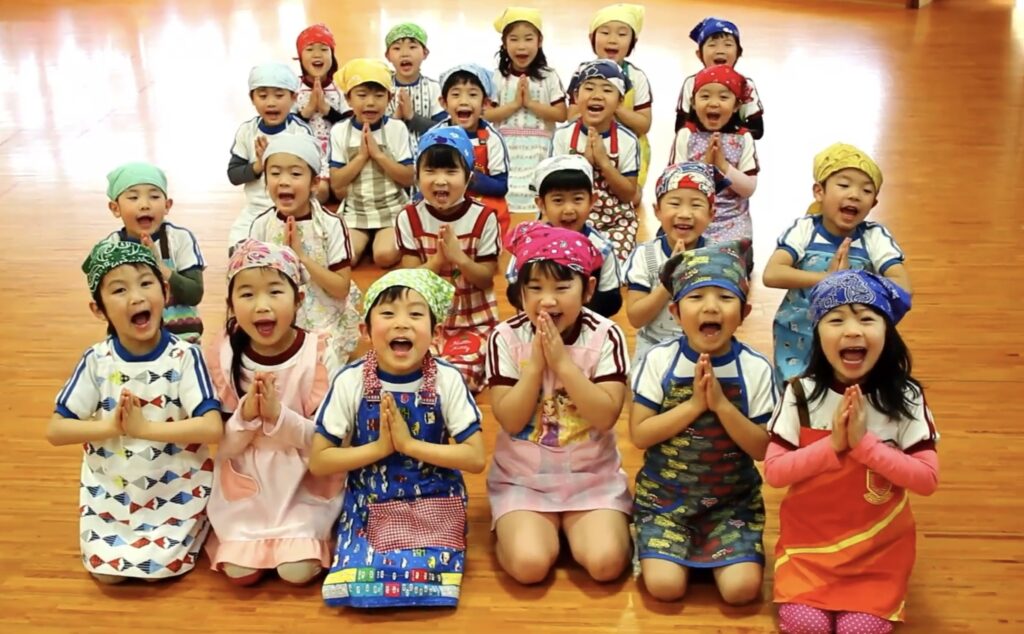
There are six sound units: i-ta-da-ki-ma-su. 'Su' can be just a consonant 's'. It is a greeting before eating a meal. The literal meaning is '(I) humbly receive'. Not for just a meal time, when you receive something from a superior person, you use 'itadakimasu' to pay respect to the superior. Who to respect can be the person who prepared the meal, such as your parents, god etc..
Here, Children are saying 'Itadaskimasu'.
11. Gochisousama(deshita)
There are six/nine sound units: go-chi-so-u-as-ma(-de-shi-ta). It is a greeting when you finish a meal. It means 'Thank you for the meal'. You may be thanking those who cooked the meal or those who provided the meal. The full version is more polite, and the short version is more casual.
For your extra knowledge, 'Gochisou' means feast. It does not matter if the meal was actually a feast or not when you say Gochsousama(deshita).
12. Ittekimasu
There is a silent unit after the first 'i'. Immediately after pronouncing 'i', you prepare to pronounce 'te', but wait for one sound unit length. You have already studied that the three sound units, 'i', 'silence', and 'te' need to be the same length. If the silent unit is too short, it will end up with 'ite'. Another frequent error is to pronounce 'i' too long. It ends up 'iite'. The next are wrong examples:
Search Online metronome on the internet. You can easily find many free Metronomes. Use one to practice the silent unit. Set 100 bpm to start with. You can gradually make it faster when you feel OK with the silent unit. With or without a silent unit would make different words, such as 'saka(slope)' and 'sakka(author)', so it matters.
There are six sound units: i-(silence)-te-ki-ma-su. It is a greeting when you leave your home. It literally means ‘I am going and coming back’. It is made of two parts. The first ‘itte’ is a verb ‘ikimasu (to go)’ in linking form. The second half is a verb ‘kimasu (to come over)’. The first verb is linked to the second verb, so it takes a linking form. When you learn about verb linking form this ‘itte’ suddenly comes under the spotlight.
13. Tadaima
When you get back home, you say 'Ta-da-i-ma'. It means 'I am home'. The literal meaning is 'Right now', and it was the beginning of a longer phrase ', Right now I am back home'. Then, the beginning of the phrase became independent because if you say the beginning, it suggests the following parts.
14. Omedetou-gozaimasu
You have already learnt the second half, go-za-i-ma-su, in sections 2 and 4. If you add O-me-de-to-u before it, it means Congratulations (with politeness). If someone passes an examination, gets married, has a baby, etc., you can say Omedetou-gozaimasu.
For New Year they say:
Akemashite Omedetou-gozaimasu
When dawn comes, they use the verb Akemasu. Therefore, this New Year greeting has to be after you wake up on New Year's Day. In English, you can say Happy New Year immediately after midnight bells, but Akemashite Omedetou Gozaimasu does not work in the same way.
15. Doumo
The previous 'Tadaima' reminded me of a handy short phrase, 'Do-u-mo'. You can use it for casual 'Thanks' or 'Hello'. Originally, it added the meaning 'very much' to 'Thank you' or 'I apologise' (please look at section 2), but the first 'Doumo' part became independent. I have just said 'Doumo' to a delivery person (during winter months, I stay in Japan).
16. Ogenkidesuka
Sometimes, Japanese learners want to say what they usually say in their languages. I like those phrases. ‘How are you?’ Is a good example. In Japanese, it is O-ge-n-ki-de-su-ka. The last ‘ka’ turns the sentence into a question. You do not need to change word order when it’s a question. Just say as usual and add ‘ka’ at the end. ‘Genki’ means ‘well/healthy/lively’, and the ‘o’ before ‘Genki’ is to respect the listener. ‘desu’ is one way to end a sentence. In question sentences, you add ‘ka’ after it.
I have made a Quizlet activity and a Wordwall activity.