1. Days of the week
にちようび
Sunday
げつようび
Monday
かようび
Tuesday
すいようび
Wednesday
もくようび
Thursday
きんようび
Friday
どようび
Saturday
Days of the week in Japanese are named after the Sun, the Moon, and the planets. They came from India via China in the 9th century and were used only for fortune-telling. When Japan began westernisation in 1868 after the Samurai era, they adopted the system widely.
As you can see, the words end in ようび (yo-u-bi). It is the days-of-the-week suffix. Let's check the parts before the ようび suffix.
にち(Ni-chi) is a Chinese origin sound for a Kanji (=Chinese character) 日. It means the Sun.
For Kanji, please have a look at a page on the writing system.
げつ(Ge-tsu) is a Chinese-origin sound for the Kanji 月. It means the Moon.
For Tuesday to Friday, I want to explain the 'Five Elements Theory' first.
Five Elements Theory
The world around us is made of five elements. Wood, fire, earth(soil), metal, and water. This theory was born at least 2500 years ago in China and you can still see the application of the theory everywhere. It has been with Japanese culture for almost forever, so people naturally live without noticing it.
Creative cycle
Wood makes Fire - imagine a wildfire or starting fire by rubbing wood sticks
Fire makes ashes and soil (Earth) - fire burns things and leaves ash, which makes soil
Earth makes Metal - earth produces ore from which metal is created.
Metal makes Water - on a metal surface, water condenses
Water creates Wood - giving water grows trees
I can give you interesting examples of how the Five Element Theory is applied, but I will talk about them when I have opportunities on other topics. Let's go back to where we were:
か(Ka) is a Chinese-origin sound for the Kanji 火. It means Fire.
すい(Su-i) is a Chinese-origin sound for the Kanji 水. It means Water.
もく(Mo-ku) is a Chinese-origin sound for the Kanji 木. It means Wood/Tree.
きん(Ki-n) is a Chinese-origin sound for the Kanji 金. It means Metal/Gold.
ど(Do) is a Chinese-origin sound for the Kanji 土. It means Earth/Soil.
The suffix for the days of the week, ようび(yo-u-bi), is always at the end, so what you need to remember is にち(ni-chi), げつ(ge-tsu), か(ka), すい(su-i), もく(mo-ku), きん(ki-n), ど(do), and its order.
A mnemonic
I have a mnemonic for you. Please read the following story.
Nick Nibble was not what you’d call ordinary.
He was the sort of boy who could turn homework into confetti and breakfast into disaster.
One stormy night, while mashing buttons on his favourite game, Sumo Kingdom Showdown, the screen suddenly fizzed and popped like a bottle of lemonade.
“CONGRATULATIONS!” it blared.
“YOUR CAB TO THE SUMO KINGDOM IS ON ITS WAY.”
Nick snorted. “Yeah, right.”
Then — HONK! HONK! — a taxi as bright as a banana and twice as loud screeched to a halt outside his window.
The driver was enormous, round as a pudding, and wearing… a sumo belt.
“Sumo Kingdom?” Nick squeaked.
The driver nodded once, very solemnly, and the cab whooshed straight up into the clouds, leaving nothing but a whiff of soy sauce behind.
They landed in a colossal arena where hundreds of sumo wrestlers stomped and cheered.
A referee with eyebrows like caterpillars handed Nick a helmet the size of a pumpkin.
“Welcome, tiny warrior!” he boomed. “Prepare to bounce!”
Nick barely had time to shout “Wait—!” before he was launched into the air, spinning like a dumpling in a frying pan.
The crowd roared with laughter and threw rice into the sky.
When Nick woke up the next morning, he was back in his bed — but his slippers were full of rice, and his game now said:
“THANKS FOR PLAYING, SUMO CHAMPION.”
Nick grinned. “Best cab ride ever.”
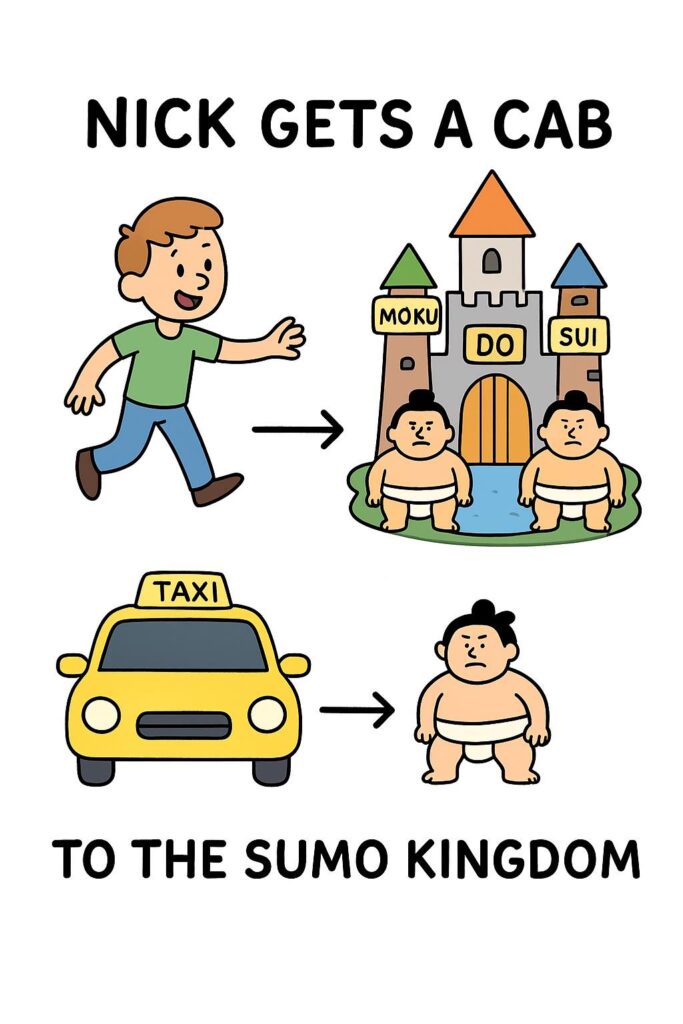
"Nick gets a cab to the sumo kingdom"
The mnemonic gives you the order of the days. Nick (ni-chi), gets (ge-tsu), cab (ka), sumo (su-i, mo-ku), kingdom (ki-n, do).
Here are some activities for you.

